




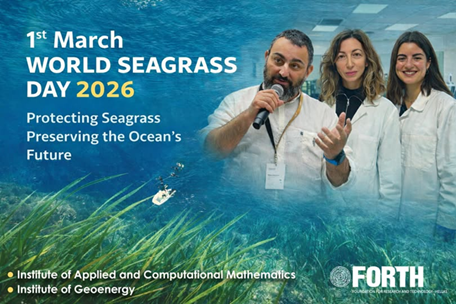
On the occasion of World Seagrass Day, the Institute of Geoenergy - FORTH highlights the crucial role of Posidonia seagrass meadows in addressing climate change and safeguarding marine biodiversity.
Posidonia meadows are among the most important blue carbon ecosystems worldwide. Through photosynthesis, they absorb carbon dioxide and store organic carbon within underlying sediments for thousands of years, due to the slow decomposition processes under anoxic conditions. At the same time, they provide essential habitats for numerous marine species and contribute to the stabilization of coastal zones.
Within the framework of the BLUEQ project, coordinated scientifically by Dr. Evina Gontikaki, the Institute of Geoenergy develops an innovative digital tool for the management of protected areas. The project integrates mapping data and blue carbon stock assessments in Posidonia meadows, contributing to the development of a Blue Carbon Strategy for the Adriatic and Ionian regions. This approach strengthens science-based decision-making and supports the sustainable management of coastal ecosystems.
In parallel, the Institute of Applied and Computational Mathematics - FORTH is actively engaged in seagrass research through the HE C-BLUES project, coordinated by Dr. Dimitris Poursanidis. The project is developing the European Seagrass Atlas by analysing open-access data and applying advanced mapping methodologies to better understand the spatial and temporal dynamics of seagrass meadows and their carbon storage capacity under different oceanographic conditions.
The two projects have developed strong synergies towards the creation of the first Seagrass Atlas of Crete, enhancing marine ecosystem protection and supporting the design of effective policies for climate adaptation and sustainable development.
Research and innovation remain key drivers in promoting the conservation of these valuable ecosystems, contributing to a resilient and sustainable marine environment for future generations.